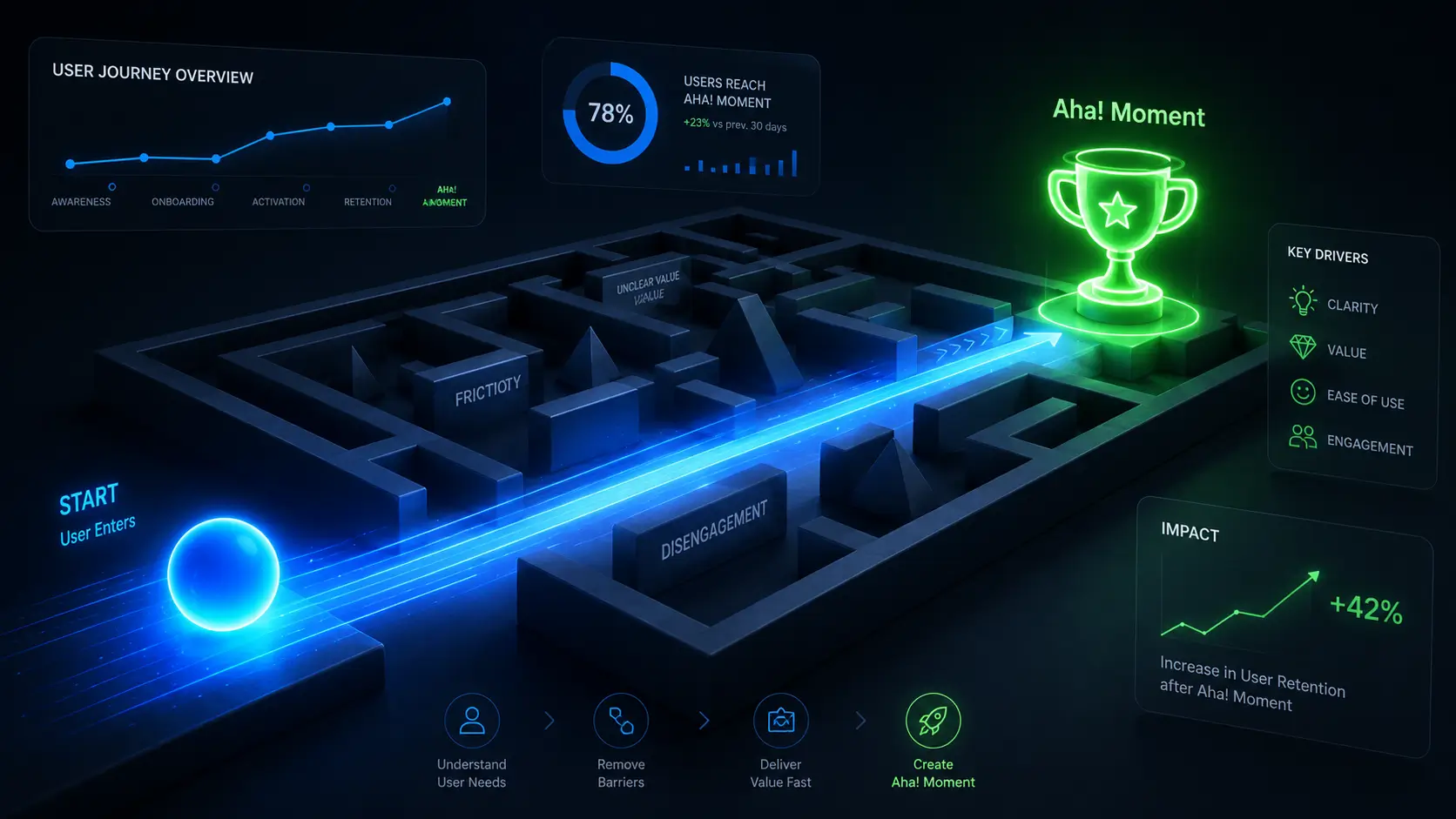
The Pageview Delusion
Most software teams, product managers, and digital entrepreneurs still worship at the altar of the pageview. They start their mornings by loading up heavy, complex dashboards to check traffic volume. They celebrate with team-wide announcements when traffic curves point upward. They plunge into emergency meetings and panic when those same curves take a sudden downward turn.
They make massive roadmap changes, pivot entire engineering sprints, and make critical product lifecycle decisions based entirely on how many times a browser fetched a specific URL or a mobile screen triggered a load event.
Here is the fundamental truth that legacy analytics platforms hide from you:
Pageviews are a marketing metric, not a product metric.
A pageview tells you absolutely nothing about whether your digital product actually creates human or economic value. Consider this scenario: a user attempts to save their work on your web application. The save button fails silently due to a JavaScript error. Out of sheer frustration, the user clicks, reloads, and refreshes the exact same page 50 times in a desperate attempt to not lose their data.
To a legacy analytics setup, that looks like an incredible spike in engagement. Your dashboard registers 50 pageviews from a single, highly active user session. The marketing team sees a healthy chart. In reality, it is an unmitigated product disaster. Your user is furious, their workflow is destroyed, and they are currently looking for a competitor's alternative.
Marketing necessarily cares about volume, acquisition, and top-of-funnel reach. Product must care about value, retention, and deep behavioral adoption. They are fundamentally distinct disciplines, yet most software products are still managed using metrics built for 1990s media websites.
The Hard Truth:
A pageview is just a mechanical heartbeat. It tells you the client browser is alive and pinging your server. It does not tell you if the human being sitting behind the glass is thriving, satisfied, or getting a single ounce of real utility out of your interface.
As the global software ecosystem rapidly shifts toward a privacy-first product analytics paradigm, relying on raw traffic counts isn't just an outdated habit—it is a critical blind spot that directly damages your retention, inflates your churn, and tanks your return on investment (ROI). To build an evergreen digital product that survives over the long haul, you must decouple your product management strategy from legacy traffic data and transition to deep, behavior-driven product metrics.
Why Traditional Metrics Fail Modern Product Teams
To understand why we need a new framework, we must first deconstruct the structural flaws of traditional web analytics. These legacy metrics were designed during an era when the internet consisted of static HTML documents linked together. In that world, moving from one page to another was the primary indicator of user action.
Today, modern web applications operate as Single Page Applications (SPAs) or interactive, state-driven interfaces where a user can spend two hours accomplishing complex data analysis, collaborating with teammates, or managing transactions without ever changing the underlying URL. In this environment, traditional telemetry fails completely.
Let us look at three "classic" web metrics and why they distort your modern product development strategy:
1. Pageviews and Screen Loads
- What it measures: The number of times an asset is requested by a client browser or an event listener registers a view.
- What it completely misses: User intent, operational success, cognitive load, and immediate satisfaction.
- The structural lie: The false assumption that a high volume of pageviews equals high user engagement. In reality, a high number of pageviews within a concentrated timeframe is frequently a reliable indicator that your user interface is highly confusing, your navigation menu is poorly structured, or your application is suffering from technical performance bottlenecks that force constant manual reloads.
2. Sessions and Session Duration
- What it measures: An arbitrary grouping of user interactions that occur within a pre-defined time window (usually resetting after 30 minutes of inactivity).
- What it completely misses: Whether the time spent on the platform was spent productively or wasted entirely in a state of confusion.
- The structural lie: The belief that longer sessions mean your product is highly addictive and valuable. If a user requires 45 minutes to find and export a simple monthly CSV financial report—a task that should ideally take three clicks and 15 seconds—ა legacy dashboard flags this as a highly engaged, 45-minute session. In truth, your product has an onboarding and usability flaw that actively drains your user's time.
3. Bounce Rate
- What it measures: The percentage of visitors who enter the site and leave without triggering a second request or interacting further with the page within that specific session window.
- What it completely misses: Contextual task completion and quick value extraction.
- The structural lie: The generalized assumption that a high bounce rate is an automatic indicator of a broken, unappealing page. If you run a utility tool, a documentation page, or a clean dashboard layout, a user might arrive via a deep link, read exactly what they need in 20 seconds, copy an API token or an analytics snippet, and close the tab completely satisfied. The task was executed flawlessly, yet your analytics system flags it as a "bounce," penalizing your performance metrics.
The underlying pattern across all legacy telemetry is clear: traditional web tracking measures superficial digital activity rather than actual human achievement. They count what data packets moved back and forth, but they never explain why it mattered to the end user's operational goals.
Metric #1: Task Completion Rate (TCR)
If you strip away all the vanity metrics from your database, you are left with one core operational truth: users do not buy software because they want to use software. They buy software because they want to achieve a specific outcome or automate a painful problem. Therefore, the definitive foundation of privacy-first product analytics is the Task Completion Rate (TCR).
Instead of tracking every single movement a user makes across your site—which requires heavy data collection, violates modern privacy preferences, and generates endless noise—you focus your telemetry entirely on the primary functional events that represent true user utility.
To implement TCR effectively, you must first ruthlessly identify your product's Core Functional Event (CFE). This is the single, non-negotiable action a user must complete to unlock value from your platform. If they do not hit this event, their signup is functionally dead, regardless of how many other screens they looked at.
- For Dropbox: The CFE is uploading the first file into a secure folder.
- For Zoom: The CFE is successfully initializing or joining an active video meeting.
- For Calendly: The CFE is a third party successfully booking an open time slot on a user's link.
- For Shopify: The CFE is launching a live, public product listing that can accept payments.
- For Weboden: The CFE is successfully installing the lightweight tracking script on a remote domain and receiving the first validation ping.
Once you have isolated your product's unique Core Functional Event, you calculate your Task Completion Rate using a simple, un-gameable formula:
$$\text{Task Completion Rate (TCR)} = \left( \frac{\text{Unique Users Who Complete the CFE}}{\text{Total Unique Users Who Initiated the Flow}} \right) \times 100$$
Why TCR is Your Best Retention Predictor
A new user who signs up for your platform but fails to complete the core functional event during their initial lifecycle window is a guaranteed churn risk. They have expended energy, created an account, navigated your setup, and walked away empty-handed. It does not matter if your marketing funnel was flawless or if your landing page design won awards—if the TCR is low, your conversion funnel is broken.
Focusing on TCR allows you to measure product health cleanly without resorting to invasive, cross-site identity tracking. You do not need to know the user's demographic history or monitor their behavior outside your app; you only need to look at the clean, anonymous completion metrics of your core flow.
Real-World Case Study: Redesigning the Invite Loop
A business-to-business (B2B) SaaS platform built for team collaboration noticed that while their user acquisition numbers were scaling rapidly month-over-month, their day-30 user retention metrics were in a steep decline. The leadership team initially blamed marketing for bringing in low-quality leads and demanded more budget for traffic acquisition.
However, an audit of their product analytics revealed a deeper issue: their identified Core Functional Event was "Inviting the First Teammate," because their internal data showed that single-user accounts had a 90% churn rate within two weeks. When they analyzed their Task Completion Rate for this specific flow, they discovered that only 22% of new signups successfully invited a teammate during their first seven days.
By digging into the behavioral steps, they found that the invite mechanism was buried deep within a secondary settings menu, requiring a user to navigate through four separate pages to execute the task. The engineering team immediately restructured the onboarding sprint, making the teammate invite step a clear, one-click action built directly into the primary dashboard layout.
The results were immediate: the Task Completion Rate climbed from 22% to 68% within 30 days. Because users were now completing the core action that made the software useful, the platform’s overall day-30 user retention doubled, stabilizing their revenue projection without spending an extra dollar on traffic acquisition.
Metric #2: Time-to-Value (TTV)
In the modern digital economy, consumer patience is at an all-time low. Whether you are building a consumer app or an enterprise B2B platform, you are competing against an ecosystem of instant gratification. The metric that governs this critical initial window of user experience is Time-to-Value (TTV).
Time-to-Value measures the exact duration of clock time that elapses from the very second a user clicks your "Sign Up" or "Get Started" button to the exact millisecond they experience their first "Aha!" moment—the point where they realize your product actually solves their immediate pain point.
TTV is not a fuzzy, psychological concept; it is a hard behavioral metric that can be tracked down to the millisecond using clean event logging.
The Brutal Correlation: TTV vs. 30-Day Retention
Industry benchmarks consistently show a harsh, linear correlation between extended TTV and immediate user churn. Every extra second or unnecessary hurdle you force a user to navigate acts as a major point of friction that degrades your conversion rate.
Here is how the timeline directly impacts your 30-Day User Retention Rate:
- TTV Less than 2 minutes:Average Retention: 85%Operational State: World-Class Frictionless Flow. Users get immediate rewards.
- Average Retention: 85%
- Operational State: World-Class Frictionless Flow. Users get immediate rewards.
- TTV of 2 to 5 minutes:Average Retention: 65%Operational State: Acceptable, but room for optimization. Minor friction points exist.
- Average Retention: 65%
- Operational State: Acceptable, but room for optimization. Minor friction points exist.
- TTV of 5 to 10 minutes:Average Retention: 45%Operational State: High Friction Danger Zone. Users are beginning to lose patience.
- Average Retention: 45%
- Operational State: High Friction Danger Zone. Users are beginning to lose patience.
- TTV More than 10 minutes:Average Retention: 22%Operational State: Product Lifecycle Crisis. Heavy drop-offs before any value is generated.
- Average Retention: 22%
- Operational State: Product Lifecycle Crisis. Heavy drop-offs before any value is generated.
If your product forces a user to spend more than ten minutes configuring setups, verifying multi-stage emails, reading instructional text, and building profiles before they can see a single real-world result, you are actively throwing away nearly 80% of your hard-earned acquisition traffic.
Strategic Frameworks for Ruthlessly Reducing TTV
To optimize your TTV, you must review your onboarding flow like a forensic investigator and eliminate any step that does not directly serve the core functional event.
- Kill the "Welcome Tour": Most product teams spend weeks building multi-step interactive pop-up tours that point to various buttons on the UI ("Click here to see settings!"). Data reveals that the vast majority of users find these pop-ups highly annoying and click the close button immediately without reading them. Instead of teaching users about your product, design the interface to guide them directly to their first successful action.
- Postpone Profile Customization: Do not demand that a user upload a profile picture, pick a custom theme color, select their job title from a long dropdown list, or fill out extensive team profiles before they use the core tool. Push all non-essential configuration options into a post-value lifecycle phase. Get them into the tool first, let them win, and let them customize their profile later.
- Implement Progressive Profiling: If your engineering or sales team genuinely needs user data for qualification, gather it gradually over time based on usage, rather than front-loading it all into a massive, multi-field registration form that kills conversion velocity.
Real-World Example: The "Skip" Button Revolution
A project management software provider noticed that their user activation metrics were plateauing. Their onboarding experience required every new account to manually input a company name, invite at least three separate team members via email fields, create their first project bucket, select a project template methodology (Agile, Kanban, or Scrum), and set up five initial tasks before they were finally allowed to see the main application dashboard.
The average Time-to-Value for this workflow was a sluggish 12 minutes. Their day-30 user retention rate was pinned at a disappointing 18%.
The product team decided to run a radical experiment. They stripped out the entire onboarding flow and replaced it with a single, high-contrast dashboard containing pre-populated sample data, along with a prominent "Skip All Setup" button at registration. If a user clicked "Skip," they were dropped into a live, functional sandbox workspace within 90 seconds, allowing them to instantly drag, drop, and test cards.
By allowing users to see the dashboard immediately rather than forcing them to build it first, their TTV dropped from 12 minutes to under 90 seconds. Consequently, their day-30 user retention rate surged from 18% to 57%, demonstrating that speed to value is the single greatest competitive advantage a digital product can possess.
Metric #3: Feature Adoption Depth
When a software company ships a highly anticipated new feature, the product management team typically measures success by building a basic telemetry query: How many total users clicked on this new feature button this week?
If the line goes up, the product manager builds a slide deck, celebrates a successful deployment with the executive team, and moves on to the next item on the roadmap.
This approach creates a dangerous product echo chamber. Tracking feature usage as a simplistic, binary metric (clicked vs. not clicked) gives teams a false sense of security. To build a product with a genuinely sticky user base, you must measure Feature Adoption Depth, not just shallow feature breadth.
The Chasm Between Shallow and Deep Usage
- Shallow Feature Usage: This occurs when a user clicks on a new feature link once purely out of curiosity or because a prominent UI banner prompted them to do so. They land on the feature page, don't understand how it applies to their workflow, encounter a learning curve, and leave immediately, never triggering that specific event again. They checked your deployment tracker box, but they derived zero ongoing business value.
- Deep Feature Usage: This occurs when a user discovers a feature, understands its utility, and embeds it directly into their regular operational routines. They trigger the feature frequently, rely on its data output, and incorporate it into their workflows. The feature transitions from a novelty into a daily or weekly habit.
Data consistently shows that users who utilize three or fewer core features deeply exhibit up to an 80% lower churn rate and generate 5 to 10 times more customer lifetime value than users who superficially click on ten different features once and never return. Deep users become your vocal brand advocates; shallow users are simply passing through your funnel on their way to cancellation.
How to Monitor Depth Without Invasive Telemetry
To measure feature depth accurately without implementing privacy-invasive user-identity cross-tracking, you should break your user retention metrics down into three clean, anonymous behavioral vectors:
- Frequency: How many distinct operational days within a specific week or month does an active user session trigger the specific feature endpoint?
- Recency: What is the precise time elapsed since the feature was last triggered by an active session?
- Intensity: How many distinct core functional actions are executed per active product session?
Analyzing the interplay between Intensity and Frequency allows you to quickly distinguish between highly successful power users and highly confused users who need immediate UI support.
The Behavioral Diagnostic Matrix:
- High Intensity / Low Frequency (The Confused User):Triggers an event 40 times in a single session, then never returns. This profile is highly indicative of a user who is stuck in an infinite error loop or is completely lost within a broken UI flow.
- High Intensity / High Frequency (The Power User):Triggers the feature consistently and intensively across every active session. This user has deeply integrated the tool into their daily habit and business operations.
- Low Intensity / Low Frequency (The Churn Risk):Rarely logs in, and when they do, they barely interact with the interface. This user is receiving minimal value and is highly likely to cancel their subscription soon.
- Low Intensity / High Frequency (The Utility User):Logs in regularly but triggers the event only once or twice per session. They know exactly what they need, extract it efficiently, and exit. Their behavior is stable and healthy.
By tracking feature adoption depth through anonymous event frequency and intensity, you can easily identify exactly where your product roadmap is creating genuine user habits and where it is simply generating noise.
Metric #4: Stickiness Ratio (With Essential Context)
Stickiness is one of the most widely cited metrics in the product analytics ecosystem. It is traditionally calculated by taking your Daily Active Users (DAU) and dividing them by your Monthly Active Users (MAU) to express a percentage ratio:
$$\text{Stickiness Ratio} = \left( \frac{\text{Daily Active Users (DAU)}}{\text{Monthly Active Users (MAU)}} \right) \times 100$$
In standard silicon valley product playbooks, a stickiness ratio above 20% is considered the baseline for a healthy software product, while anything pushing north of 40% is heralded as a world-class, highly addictive platform.
However, in the contemporary era of cookieless analytics and specialized software tools, tracking your stickiness ratio without clear, structural context is a major operational trap.
The Dangerous Illusion of Raw Stickiness
A high raw stickiness ratio can easily mask deep underlying product flaws. If your digital application features a highly unstable backend, a confusing data-entry flow, or a buggy billing form, your users may be forced to log in four or five times every single day just to check if their data went through or to re-attempt a failed task.
Your telemetry dashboard sees a massive spike in unique Daily Active Users. Your investors see a beautiful, high-percentage stickiness curve. In reality, your brand equity is rapidly deteriorating, and your users are building up massive resentment against your interface. Your high stickiness isn't an indicator of product value; it is a direct measurement of user frustration.
Conversely, a low raw stickiness ratio does not automatically mean your digital product is failing. The value of stickiness is entirely dependent on the natural usage cadence of your specific product category.
Establishing Your Real Category Baselines
To use the stickiness ratio as an effective diagnostic tool rather than a vanity goal, you must benchmark your percentages against the realistic lifecycle requirements of your software niche:
- Daily-Use Applications (Communication platforms, Email infrastructure, Social ecosystems): For these tools, high stickiness ($\text{DAU}/\text{MAU} > 30\%$) is an absolute requirement for long-term commercial survival. If users do not check these platforms daily, the network effect collapses.
- Weekly-Use Applications (Project management portals, Developer sprint boards, B2B CRM dashboards): For these products, a medium stickiness ratio ($\text{DAU}/\text{MAU}$ between $10\%$ and $20\%$) is completely healthy. Users need these tools to manage specific operational cycles, not to scroll mindlessly every morning.
- Occasional-Use Applications (Tax filing portals, Flight search engines, Cybersecurity auditing tools, Privacy-focused report exporters): These applications have naturally low stickiness profiles. A user may only require a tax application once a year, or an enterprise privacy audit engine once a month. Forcing gamified mechanics or notifications to artificially pump up DAU for an occasional-use tool is a counter-productive distraction that alienates your core audience.
The rule for modern product development is simple: use your stickiness ratio strictly as an internal diagnostic signal to identify anomalies, never as an isolated corporate goal. Always cross-reference your stickiness metrics with your Task Completion Rate to ensure your daily active users are returning because they are successful, not because they are stuck.
Metric #5: The Irreplaceability Score
We now arrive at the ultimate, definitive metric for any digital product or entrepreneur: The Irreplaceability Score.
Every metric we have explored so far—Task Completion Rates, Time-to-Value curves, and Feature Adoption depths—can be tracked, queried, and visualized inside an analytics database. But the irreplaceability score measures something far deeper than raw behavioral actions; it measures your product's fundamental psychological and operational defense moat.
The irreplaceability score cannot be bought with marketing capital, and it cannot be faked with clever frontend event tracking. To calculate it, you must bypass your automated dashboards entirely, run a direct qualitative micro-survey loop, and ask your active user base a simple, uncompromising question:
"If our product disappeared from the face of the earth tomorrow morning, how disappointed would you be?"
You provide your users with three distinct, mutually exclusive answer pathways:
- 1. Very Disappointed: This means your platform has become an essential utility in their professional or personal life. It has cleanly woven itself into their daily routine. They rely on it to save time, secure their data, or protect their privacy. They will willingly tolerate price increases, advocate for your brand to their peers, and actively wait out any technical server downtime.
- 2. Somewhat Disappointed: This means your software provides clear utility, but your product lacks a deep competitive moat. Your user interface is clean, but the core features are easily replicable. Your users like you, but the moment a competitor launches a slightly cheaper alternative or a flashier frontend layout, they will migrate their data without hesitation.
- 3. Not Disappointed at All: This means your software has become a generic, interchangeable commodity. The user is entirely indifferent to your brand. They likely signed up due to a discount or an ad campaign, but they derive no deep value from your product ecosystem. They will abandon your tool the second their current subscription billing cycle concludes.
The Painful Truth Hidden by Traffic Growth
The vast majority of modern digital startups, SaaS companies, and mobile apps fall squarely into the "Not Disappointed" or "Somewhat Disappointed" categories. However, their product management and executive teams are entirely oblivious to this ticking churn bomb because they are too busy celebrating their rising pageviews, expanding social media mentions, and growing user signup charts.
Signups without long-term retention are nothing more than an expensive, slow-motion churn disaster. Customer acquisition strategies built entirely on top-of-funnel traffic velocity will eventually burn through their budget if the product fails to build deep customer loyalty.
If your internal qualitative micro-surveys reveal that your "Very Disappointed" customer cohort is pinned below the critical 40% threshold, your product development strategy is structurally unstable. You are actively building your enterprise on sand.
No amount of marketing spend, SEO optimization, or dashboard expansion can save a product that users can lose tomorrow without feeling a single ounce of professional or personal disappointment. If you cannot prove your product's structural irreplaceability, you are running your business blind.
The Dashboard Delusion
Product engineering and design teams love beautiful, comprehensive dashboards. They spend weeks configuring telemetry pipelines, setting up tracking endpoints, and packing their screens with 50 different metrics, 20 real-time charts, and complex color-coded alert zones. They load up these dashboards on massive monitors in their offices and review them every morning over coffee.
And day after day, they learn absolutely nothing new about their users.
This is the great operational paradox of modern data tracking: the larger and more crowded your telemetry dashboard becomes, the less actionable insight you can extract from it.
Dashboards are inherently historical and reactive; they are highly efficient at showing you what occurred after the fact, but they are fundamentally incapable of explaining why real human beings behaved that way.
- A legacy dashboard can cleanly show you that your day-7 user retention dropped by exactly 14% over the weekend. It cannot show you that your latest production script deployment threw a silent, unlogged formatting error that broke the user onboarding flow on mobile devices.
- A legacy dashboard can show you that your average session duration increased by an impressive 8 minutes this week. It cannot show you that your team recently added two extra steps to your checkout flow, forcing users to spend those extra 8 minutes wandering around your interface in deep frustration.
- A legacy dashboard can track thousands of pageviews across your help documentation portal. It cannot tell you whether those visitors found the answers they needed or gave up entirely and closed the tab in disgust.
The path forward for high-performing product teams is clear: stop building bigger dashboards to admire, and start testing behavioral hypotheses.
Instead of tracking every single click just because you have the storage capacity, limit your core tracking suite to a minimal set of clean metrics that map directly to real-world user value. Use your data tools to actively test specific product ideas, uncover friction points, and clear the path for your users, rather than getting buried under an avalanche of irrelevant traffic stats.
The Action Gap: From Data to Execution
Gathering high-quality product metrics is an expensive and time-consuming endeavor. Yet, the vast majority of software companies suffer from a massive operational failure known as The Action Gap.
They invest significant engineering resources into tracking events, organizing data warehouses, and routing telemetry pipelines into their communication channels. Then, they do absolutely nothing with the data. The metrics sit undisturbed inside heavy dashboards, the dashboards remain unread, and product roadmaps continue to be driven entirely by internal corporate politics or subjective intuition.
Metrics without an immediate, pre-defined operational response are nothing more than an expensive form of corporate anxiety. Every single behavioral metric you select to track inside your product analytics suite must be explicitly tied to a matching engineering or design action. If a metric moves past a certain threshold, the team should already know exactly what experiment, audit, or optimization loop to execute next.
To bridge the action gap efficiently, your team can deploy this direct, 5-question product optimization framework:
1. Do users actually get real value?
- Modern Product Metric: Task Completion Rate (TCR)
- Immediate Operational Action: Audit and re-engineer broken user paths; eliminate unnecessary steps in the core flow.
2. How fast do they unlock that value?
- Modern Product Metric: Time-to-Value (TTV)
- Immediate Operational Action: Ruthlessly strip out form fields, skip tutorials, and eliminate mandatory setup friction.
3. Are they adopting features deeply?
- Modern Product Metric: Feature Adoption Depth
- Immediate Operational Action: Revamp your contextual onboarding; build targeted feature prompts based on usage.
4. Are they returning or just stuck?
- Modern Product Metric: Stickiness Ratio (with context)
- Immediate Operational Action: Run session path deep-dives to discover whether active users are successful or frustrated.
5. Would they truly miss our tool?
- Modern Product Metric: Irreplaceability Score
- Immediate Operational Action: Pivot your product roadmap to double down on your core, high-value feature set.
If you are currently tracking an event, a metric, or a custom click-stream that cannot be directly mapped to one of these five operational actions, delete that metric from your codebase immediately. It is generating noise, draining your database resources, and confusing your product team.
Frequently Asked Questions
Q1: Can I completely ignore pageviews in a modern product stack?
No. Pageviews and screen loads remain highly effective metrics for top-of-funnel marketing teams, content strategists, advertising performance management, and tracking your technical SEO indexing health inside Google Search Console.
However, the exact millisecond a visitor completes your signup form, logs into an account, and transitions from a passive browser into an active user, pageviews lose all diagnostic value. For your public blog, track pageviews. For your actual digital product, rely entirely on behavior-driven event metrics.
Q2: How do I build a behavioral analytics setup that respects user privacy?
The industry standard for modern software is a transition to cookieless, privacy-first product analytics architectures powered entirely by anonymous first-party data. Instead of using cross-site tracking cookies to monitor a user’s personal identity or tracking their history across external domains, you restrict your telemetry entirely to your own application's backend infrastructure.
You log actions anonymously (e.g., "Event: Project Exported, ProjectType: Kanban") without attaching any personal identifiable information (PII). This approach gives you all the data you need to optimize your interface layout while remaining compliant with global privacy frameworks.
Q3: What is considered a dangerous Time-to-Value score for a web app?
For the vast majority of modern digital applications, e-commerce checkouts, and SaaS platforms, any initial Time-to-Value duration that stretches past the 5-minute mark is highly dangerous. If your registration system requires extensive form completions, multiple email verification steps, and long workspace configuration screens before a user can see a single real-world result, you are actively driving away a significant portion of your trial traffic.
Your ideal target should always be under 120 seconds. If your product requires a complex corporate setup, build an instant "Sandbox Mode" featuring pre-populated demo data so users can experience the core value within their first 60 seconds.
Q4: How do I track Feature Adoption Depth without utilizing heavy data science software?
You do not need an enterprise data platform to measure feature depth. You can calculate it directly with basic database queries by tracking a simple depth vector: First Trigger Event $\rightarrow$ Repeat Use (Day 7) $\rightarrow$ Sustained Habit (Day 30).
If a user triggers a feature on day 1, returns to trigger it on day 7, and continues to log at least three events per week by day 30, they have cleanly crossed the chasm from shallow usage into deep feature adoption.
Q5: What if my product has a naturally low stickiness profile?
If you build a digital utility that users naturally only need occasionally—such as an annual tax calculator, a flight booking engine, or a quarterly privacy compliance reporting tool—you should completely ignore the classic Silicon Valley requirement for a high DAU/MAU stickiness ratio. Trying to artificially force daily engagement through unnecessary notifications or gamified loops will only annoy your audience and increase your uninstalls.
Instead, focus your optimization efforts entirely on your Task Completion Rate and your Irreplaceability Score. If your users can log in once a quarter, complete their specific task in under two minutes without errors, and state that they would be highly disappointed if your company shut down, your product is highly successful, regardless of low daily active traffic.
Verdict: Stop Tracking Traffic. Start Measuring Value.
Legacy web tracking systems are designed to show you pageviews and traffic volume. Modern, privacy-compliant product analytics architectures are built to show you genuine human behavior.
Pageviews tell you how many times a browser requested a collection of files from your hosting server. Behavioral metrics tell you why real human beings are interacting with your layout, where they are getting stuck, and whether your software is actually making their lives easier.
If your business model relies entirely on a simple content media blog that monetizes through programmatic display ads, keep chasing raw pageviews and high traffic numbers. But if you manage a true digital product—a cloud-based SaaS platform, an e-commerce infrastructure, a modern marketplace, or an interactive web application—pageviews are nothing more than a dangerous distraction.
True product optimization is never about counting how many times an interface reloads; it is about ensuring your platform becomes completely irreplaceable to your core user base.
The five product metrics that matter:
- Task Completion Rate: Did they successfully achieve the outcome they signed up for?
- Time-to-Value: How fast did they experience their first meaningful win?
- Feature Adoption Depth: Are they embedding your tool into their habits, or just clicking once?
- Stickiness (With Context): Are they returning to your app because they are successful, or because your UI is confusing?
- Irreplaceability Score: Would your audience truly miss your tool if you shut down tomorrow?
Tracking these five metrics does not require complex data science pipelines or invasive user-tracking scripts. It simply requires operational honesty, a willingness to look past vanity metrics, and a commitment to measuring actual user outcomes rather than raw server activity.
Stop measuring traffic. Start measuring value. Your users will reward you with their loyalty, your retention metrics will stabilize, and your digital product will finally build a durable, long-term competitive moat.