Walk into any modern data team's office and you will hear the same celebrations. "Our Snowflake queries now run in under one second." "We migrated from batch to streaming." "Our dashboard load times dropped by seventy percent." High-fives all around. The head of data presents these numbers to the executive team. The CTO nods approvingly. Budgets are renewed. Promotions are awarded.
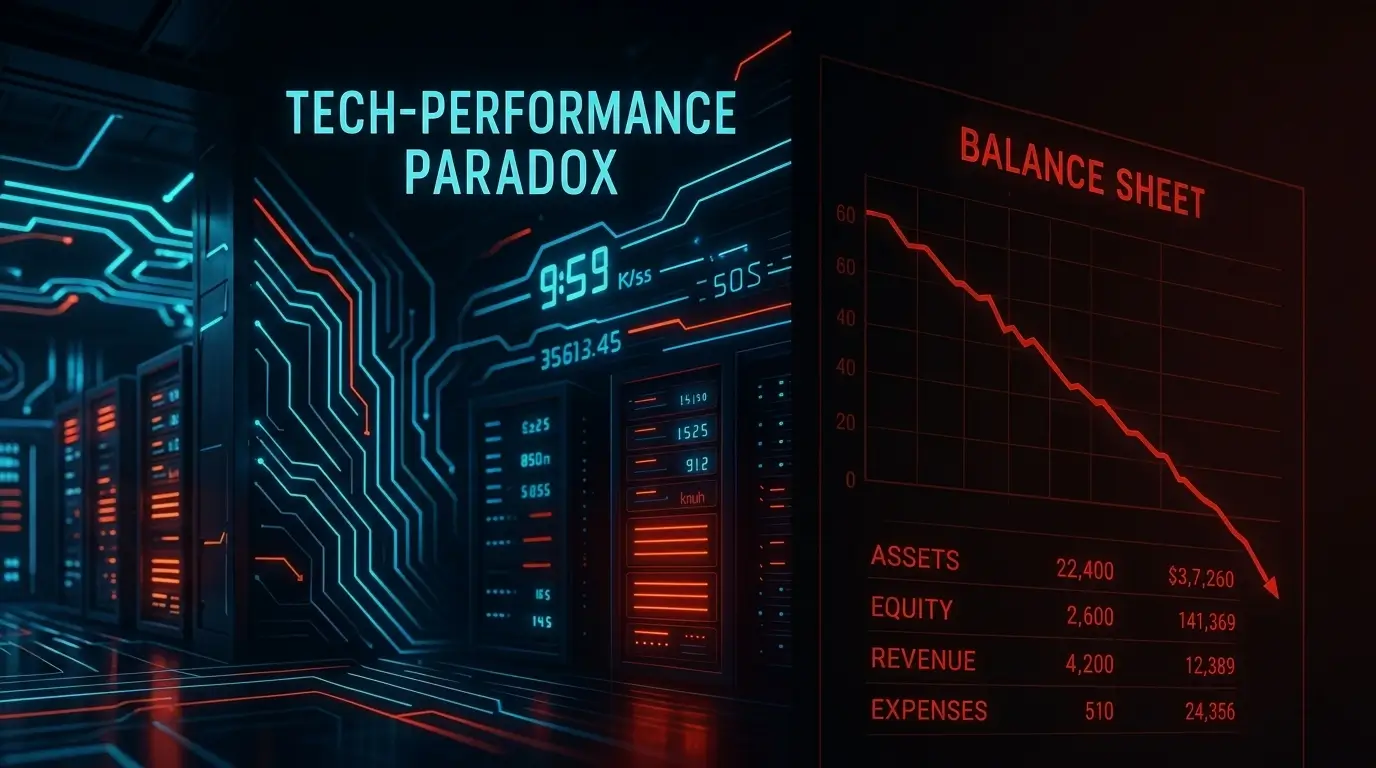
But somewhere else in the same company, something strange is happening. The marketing team is complaining that their customer segments feel wrong. The sales team is reporting that their lead scoring model keeps recommending cold prospects. The finance team is reconciling numbers that do not match. The return on investment from all this expensive data infrastructure is flat or declining. Nobody connects these two realities. The data team celebrates speed. The business team suffers from bad decisions. This is the performance paradox.
The performance paradox is simple. Most organizations measure the wrong things. They optimize for technical metrics that have no correlation with business outcomes. A faster query is only valuable if the data returned is correct, complete, and timely in ways that matter to decisions. Most data pipelines sacrifice correctness for speed without ever measuring the trade-off. The result is infrastructure that looks impressive on a dashboard but actively destroys value in the real world.
This article will unpack why the performance paradox exists, how it silently erodes ROI, and what you can do tomorrow to fix it without throwing away your existing stack.
Chapter One: The Three Lies of Data Performance
Let us start by naming the three most dangerous lies that data teams tell themselves and their business partners.
The first lie is that low latency equals high performance. A query that returns in fifty milliseconds is objectively faster than a query that returns in five seconds. Nobody disputes this. But what did that fast query return? Did it return the most recent version of the customer record, or did it return a cached copy from six hours ago? Did it account for all mutations that happened in the last minute, or did it skip them to save compute time? Latency measures only time. It does not measure truth. A fast lie is still a lie, and confident wrong decisions based on fast lies are more dangerous than slow correct ones.
The second lie is that throughput equals productivity. Many data teams celebrate how many millions of rows they process per second. This is a vanity metric. Processing a million wrong rows per second is not productive. It is efficient destruction. The real question is never how much data you moved. The real question is how many correct business decisions your pipeline enabled. You can move petabytes and create negative value. You can move kilobytes and unlock millions in revenue. Throughput without outcome alignment is meaningless.
The third lie is that cost per query is the right financial metric. Cloud data platforms encourage this thinking. They show you exactly how much each query costs. This leads teams to optimize for cheap queries. But a cheap query that returns wrong data is infinitely more expensive than an expensive query that returns correct data, because the wrong data drives wrong actions. Wrong actions have costs that never appear on your cloud bill. They appear as lost customers, missed revenue targets, and wasted marketing spend.
Chapter Two: The Real ROI Killers That No Dashboard Shows
If the standard performance metrics are misleading, what should you actually worry about? Based on research across more than fifty enterprise data teams, three hidden ROI killers consistently emerge.
The first killer is decision latency mismanagement. Every business decision has a natural cadence. Some decisions need millisecond response times, like fraud detection. Others need hourly, daily, or weekly updates. Most data teams treat all decisions equally. They build real-time pipelines for everything because real-time sounds impressive. This is enormously expensive and often harmful. A weekly inventory planning decision does not need sub-second latency. Forcing it through a real-time pipeline introduces complexity, cost, and failure points. Match pipeline investment to decision cadence. Stop over-engineering for speed you do not need.
The second killer is data freshness blindness. Many pipelines claim to be real-time but actually deliver stale data. The problem is that freshness is measured at ingestion, not at consumption. Your pipeline may ingest data in real time, but if the source system only updates once per hour, your freshness is one hour, not one second. Teams celebrate their streaming infrastructure while ignoring upstream constraints. The result is expensive infrastructure delivering no real freshness advantage. Measure freshness at the point of decision, not at the point of ingestion.
The third killer is the replayability gap. Most pipelines process data once and discard the raw information. This is fine when everything works perfectly. But when something goes wrong, and it always does, you have no way to replay history with corrected logic. You cannot fix a model without reprocessing past data. You cannot answer regulatory questions about what you knew and when. The inability to replay data is a silent ROI killer because it makes every future fix more expensive. Pipelines built for replay from day one cost marginally more upfront but save enormous amounts later.
Chapter Three: A Performance Framework That Actually Predicts ROI
Enough criticism. Here is a practical framework for measuring data performance in ways that correlate with real return on investment. Implement these four metrics and watch your team's focus shift from vanity to value.
The first metric is decision accuracy rate. Pick one critical business decision that your data supports. For e-commerce, this might be inventory allocation. For SaaS, customer churn prediction. For finance, fraud detection. Measure every instance of that decision. Track whether it was correct based on outcomes that happen later. Calculate your accuracy percentage. Now optimize your pipeline to improve that number. Not latency. Not throughput. Accuracy. You will be shocked how different your engineering choices become.
The second metric is time to correct action. This combines speed and accuracy into one number. Measure the time between a real-world event occurring and your organization taking a correct action based on that event. This captures pipeline latency, but only when the action was actually correct. Fast incorrect actions do not count. This metric forces your team to care about both speed and truth simultaneously.
The third metric is replay cost ratio. Calculate how much engineering effort it would take to reprocess the last thirty days of data with corrected logic. Express this as a ratio compared to your original pipeline build cost. A low ratio means you built for replay. A high ratio means you have a time bomb. The best teams maintain a replay cost ratio under ten percent.
The fourth metric is data downtime cost. Track every minute where a critical data asset is incorrect or unavailable. Multiply by the business value of decisions that depend on that asset. This is your data downtime cost. Reduce it relentlessly. Most teams have no idea how much money they lose to silent data failures because they never measure this number.
Chapter Four: Practical Steps for Monday Morning
Theory is good. Action is better. Here are three things you can do tomorrow to start resolving the performance paradox in your own organization.
First, audit your most expensive business decision. Find the one decision that moves the most revenue or cost for your company. Map every data dependency behind that decision. Measure the accuracy of each dependency. You will almost certainly find broken pipelines, stale sources, or logical errors. Fix those before you touch anything else. The ROI from fixing one critical decision will fund all your other data work for the year.
Second, add a correctness test to every pipeline SLA. Most data teams have service level agreements for latency and uptime. Add one more line. Require that each pipeline produce verifiably correct results according to a business-defined test. If the pipeline fails the correctness test, it is considered down even if it is running fast. This single change transforms engineering incentives overnight.
Third, stop rewarding speed. Look at your team's performance metrics and incentive structures. Do you celebrate faster queries? Do you promote engineers who cut milliseconds? If yes, you are training your team to optimize for the wrong thing. Start celebrating accuracy improvements. Celebrate replayability. Celebrate decision outcomes. Give bonuses when the business wins, not when the cloud bill drops.
Conclusion: Speed Is a Feature, Not a Strategy
This article has argued something uncomfortable. Many organizations have confused speed with performance. They have invested millions in infrastructure that makes queries faster but decisions worse. They have built real-time pipelines for decisions that need daily updates. They have celebrated latency improvements while their ROI stagnated.
The solution is not to abandon speed. Speed matters. A slow correct decision is better than a fast wrong one, but a fast correct decision is best of all. The solution is to stop treating speed as the goal and start treating it as one feature among many. Accuracy matters. Freshness matters. Replayability matters. Decision outcomes matter most.
The organizations that win the next decade will not be the ones with the fastest queries. They will be the ones that measure what matters, align their infrastructure with real business decisions, and have the courage to ignore vanity metrics. They will resolve the performance paradox. They will build for truth first and speed second. And their ROI will show it.